Introduction
For more than half a century, silicon has been the foundation of modern electronics. Almost every computer, smartphone, microprocessor, and electronic device relies on silicon-based transistors to perform switching and amplification functions. However, as semiconductor technology continues to advance, engineers are approaching the physical limitations of traditional silicon transistors.
To overcome these challenges, researchers are exploring alternative semiconductor materials capable of delivering higher performance, lower power consumption, and improved scalability. One of the most exciting developments in this field is the creation of a non-silicon transistor based on gallium-doped indium oxide, developed by researchers at the Institute of Industrial Science, University of Tokyo.
This breakthrough could open the door to a new generation of faster, smaller, and more efficient electronic devices.
What Are Non-Silicon Transistors?
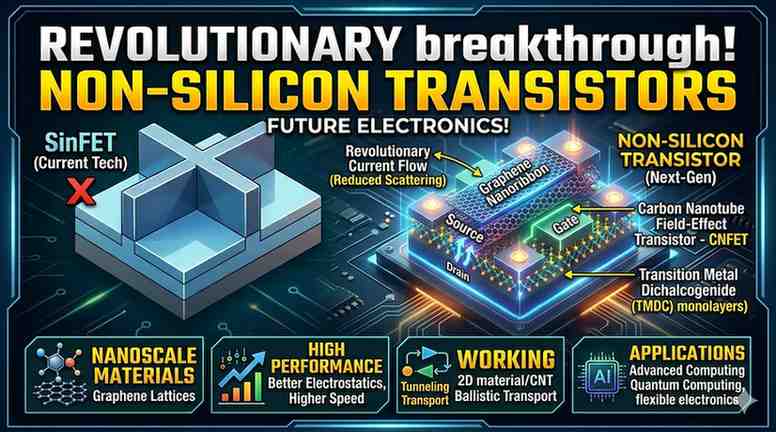
Non-silicon transistors are semiconductor devices that use materials other than silicon as the active channel material. These advanced materials are designed to overcome the limitations faced by conventional silicon transistors at extremely small dimensions.
Unlike traditional silicon-based devices, non-silicon transistors can offer:
- Higher electron mobility
- Better power efficiency
- Improved thermal stability
- Enhanced switching speed
- Greater scalability for future semiconductor nodes
As transistor sizes continue to shrink, alternative materials are becoming increasingly important for maintaining progress in electronics.
The University of Tokyo Breakthrough
Researchers at the Institute of Industrial Science, University of Tokyo, have successfully developed a cutting-edge transistor using gallium-doped indium oxide.
The research team designed a transistor structure that utilizes a Gate-All-Around (GAA) architecture, one of the most advanced transistor designs currently being explored by the semiconductor industry.
The combination of gallium-doped indium oxide and Gate-All-Around technology resulted in a transistor with remarkable electrical characteristics and enhanced performance.
What Is Gallium-Doped Indium Oxide?
Gallium-doped indium oxide is an advanced semiconductor material created by introducing gallium atoms into indium oxide.
This process, known as doping, improves the material’s electrical properties and stability.
Benefits of Gallium Doping
- Improved conductivity
- Enhanced stability
- Better control of electron flow
- Reduced electrical defects
- Increased device reliability
Researchers selected this material because of its potential to outperform conventional silicon in future transistor technologies.
Gate-All-Around (GAA) Structure
The newly developed transistor uses a Gate-All-Around (GAA) architecture.
In a GAA transistor:
- The gate completely surrounds the channel.
- Current flow is controlled from all sides.
- Leakage current is significantly reduced.
- Switching efficiency is improved.
Compared to FinFET technology, GAA transistors offer superior electrostatic control and are better suited for future semiconductor nodes below 3 nanometers.
Why Is This Discovery Important?
The semiconductor industry has relied on silicon for decades. However, silicon-based transistors are approaching their practical scaling limits.
Challenges of Silicon Technology
- Increased power leakage
- Heat generation
- Quantum effects at small scales
- Manufacturing complexity
- Reduced performance gains
Non-silicon materials provide a potential solution to these challenges.
This breakthrough demonstrates that alternative semiconductor materials can be successfully integrated into advanced transistor structures.
Key Features of the New Non-Silicon Transistor
High Electron Mobility
Electron mobility determines how quickly charge carriers move through a semiconductor material.
Higher mobility results in:
- Faster switching speeds
- Improved processor performance
- Better energy efficiency
Excellent Stability
The gallium-doped indium oxide structure maintains stable performance even under demanding operating conditions.
Improved Scalability
The technology can potentially support future semiconductor nodes beyond current silicon limitations.
Lower Power Consumption
Enhanced electrical control allows more efficient operation and reduced energy losses.
Advanced Gate-All-Around Design
The GAA architecture provides superior current control and minimizes leakage current.
Potential Applications
The development of non-silicon transistors could impact many industries.
Artificial Intelligence
AI processors require enormous computational power.
Non-silicon transistors may help deliver:
- Faster machine learning
- Improved neural network processing
- Enhanced AI accelerators
High-Performance Computing
Future supercomputers may benefit from:
- Higher processing speeds
- Better energy efficiency
- Increased transistor density
Consumer Electronics
Future smartphones, tablets, and laptops could offer:
- Longer battery life
- Faster performance
- Improved multitasking
Data Centers
Energy-efficient transistors could reduce power consumption and cooling costs in modern data centers.
Internet of Things (IoT)
Low-power electronics are essential for connected devices and smart systems.
Advantages Over Traditional Silicon Transistors
| Feature | Silicon Transistors | Gallium-Doped Indium Oxide Transistors |
|---|---|---|
| Electron Mobility | Moderate | High |
| Power Efficiency | Good | Better |
| Scalability | Limited at smaller nodes | Excellent |
| Leakage Control | Moderate | Improved |
| Future Potential | Approaching limits | High |
Future of Non-Silicon Electronics
The successful demonstration of non-silicon transistors suggests that future semiconductor technologies may increasingly rely on alternative materials.
Researchers worldwide are investigating:
- Indium oxide
- Gallium oxide
- Graphene
- Carbon nanotubes
- Two-dimensional materials
These innovations could continue the advancement of computing technology long after traditional silicon reaches its limits.
Frequently Asked Questions (FAQ)
What is a non-silicon transistor?
A non-silicon transistor is a semiconductor device that uses materials other than silicon for its active channel.
Who developed the new non-silicon transistor?
Researchers at the Institute of Industrial Science, University of Tokyo, developed the transistor using gallium-doped indium oxide.
Why is gallium-doped indium oxide important?
It provides higher electron mobility, improved stability, and better performance compared to conventional silicon in advanced transistor designs.
What is a Gate-All-Around transistor?
A Gate-All-Around (GAA) transistor is a transistor structure where the gate surrounds the channel on all sides, improving current control and efficiency.
Will non-silicon transistors replace silicon completely?
Not immediately. However, they may become increasingly important as silicon approaches its physical scaling limitations.
Conclusion
The development of non-silicon transistors using gallium-doped indium oxide represents a significant milestone in semiconductor technology. By combining advanced materials with Gate-All-Around transistor architecture, researchers have demonstrated a promising path beyond traditional silicon-based electronics.
As demand for faster processors, artificial intelligence systems, and energy-efficient devices continues to grow, non-silicon transistor technology could play a critical role in shaping the future of electronics. This breakthrough highlights the ongoing innovation within the semiconductor industry and opens exciting possibilities for next-generation computing technologies.