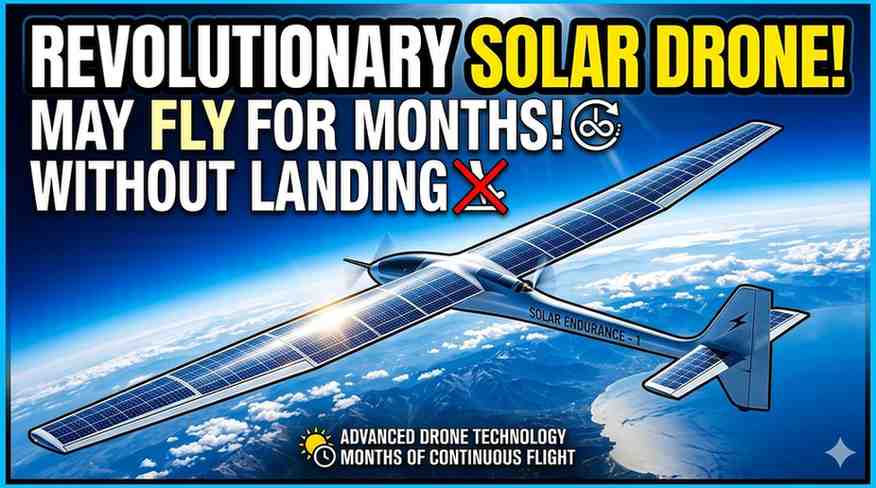
The future of flying is getting exciting as engineers work on new planes. These planes use the sun’s power to stay up in the air. This changes how we travel and watch over places.
These planes use solar drone technology to fly without fuel. This makes them better for our planet. They can watch over big areas for a long time.

This cutting-edge drone innovation is changing how we connect and watch our planet. As they get better, they’ll give us important data from high up. We’re seeing a big step forward in seeing our world.
Key Takeaways
- High-altitude aircraft now use renewable energy to stay airborne indefinitely.
- These systems provide a clean, sustainable alternative to standard fuel-based aviation.
- Global connectivity will improve through persistent aerial monitoring platforms.
- Environmental tracking becomes more efficient with long-endurance flight capabilities.
- The industry is shifting toward autonomous, long-term observation solutions.
How the Revolutionary Solar Drone May Fly for Months Without Landing
To fly for months, we need a new way of thinking about flying. A revolutionary solar drone may fly for months without landing. It uses a smart energy loop to balance power. This loop is made possible by advanced materials and software.

Harnessing High-Efficiency Photovoltaic Energy
The sun is the drone’s main power source. Engineers put photovoltaic cells on the wings to catch more sunlight. These cells turn sunlight into electricity, even in the dark skies.
This energy powers the drone’s computers and communication systems. It also charges the batteries. This way, the drone has enough energy for the night.
Managing Battery Storage and Nighttime Flight
Nights are the biggest challenge for solar drones. To overcome this, they use special batteries that are light but hold a lot of charge. These batteries are optimized for deep discharge cycles, so the drone can fly all night.
The drone switches from solar to battery power automatically. Smart systems watch the voltage levels. This keeps the drone flying smoothly until the sun comes up again.
Optimizing Aerodynamics for Perpetual Altitude
Aerodynamics is key for solar drone endurance capabilities. By reducing drag, the drone needs less power to stay aloft. Engineers use ultra-light materials to make wings that glide well in thin air.
Reducing air resistance lets the drone stay up with very little energy. This means the drone can fly all day using just a little power. Its design keeps it flying high in the sky.
Operational Steps for Deploying Long-Endurance Solar UAVs
Launching a long-endurance solar platform is more than just waiting for a clear sky. It requires a detailed plan to ensure a mission that lasts several months is successful. Teams focus on precision and safety to get the most out of these advanced systems.
Preparing the Flight Path and Weather Analysis
Before takeoff, teams study the weather deeply. A sustainable solar-powered drone needs stable air to fly straight without damage. They avoid bad weather to prevent damage during long flights.
They use weather data to find the best flight paths. This ensures the drone flies safely and gets enough sunlight. This step is key for a mission that goes without a hitch.
Executing the Launch and Initial Ascent
The launch is a crucial moment for any continuous flight solar drone. It must climb well to reach the best altitude for sunlight. Ground control watches the solar panels’ power closely during this climb.
After reaching the right altitude, the drone starts its long flight. It needs to work well with its batteries and motors. A smooth start means the drone can fly for months with enough power.
Monitoring Autonomous Navigation and Energy Balance
Modern systems are vital for these missions. They let the continuous flight solar drone change its path as needed. These systems keep track of how much energy it uses and gets from the sun.
Operators watch these systems to keep the sustainable solar-powered drone on course. This balance lets the drone fly forever without needing to land or refuel.
| Mission Phase | Primary Objective | Key Technology |
|---|---|---|
| Pre-Flight | Weather Risk Mitigation | Predictive Modeling |
| Launch | Reaching Stratosphere | High-Torque Motors |
| Cruise | Energy Equilibrium | Autonomous Navigation |
| Monitoring | System Longevity | Telemetry Sensors |
Conclusion
Solar-powered flight is a big step towards a new era of watching the sky all the time. These planes can stay up for months without needing fuel. This makes it easier to keep an eye on our planet for both business and environmental reasons.
Companies like Airbus and BAE Systems are making these planes do more. They help keep communication going in far-off places. Now, we’re moving towards a system that collects data all the time, not just for short periods.
These planes could help us understand weather better or even bring internet to remote areas. Share your thoughts on how these solar planes might change things. What do you think they’ll be used for in the next ten years? Your ideas help shape the future of flying.